SEO does not only require good writing. To ensure that the content can be discovered, writers need to know how the search engines are directed by keywords. The keywords are the words that users put in Google and search engines process these words to find out the relevance of a webpage.
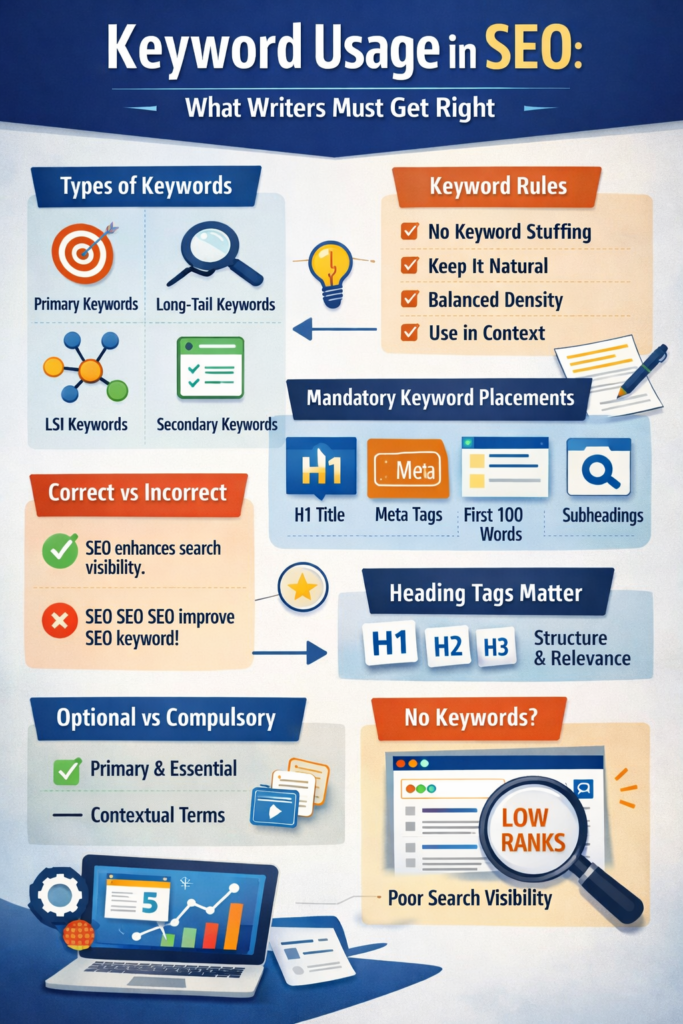
Types of Keywords
The knowledge of the type of keyword categories can assist writers in organizing the content:
• Keywords in the headline, the key point of the article.
•Secondary Keywords: supporting keywords to the topic.
• Long-tail Keywords: target-oriented search phrases.
• LSI Keywords: words that are contextually relevant and aid meaning.
Rules for Keyword Usage
The writers should observe the following practices in order to ensure the quality of SEO:
• Avoid keyword stuffing
• maintain a natural placement of keywords.
• Be readable and understandable.
Mandatory Keyword Placements
Search visibility is necessary in some of the placements:
• H1 Title
• Introduction (first 100 words)
• Subheadings (H2 / H3)
• Meta title and description
• Image alt text
Proper vs. improper Keyword Usage
Correct example:
Using relevant keywords can helps in the search engines to know the relevance of content.
Incorrect example:
“Keyword SEO keyword SEO keyword SEO content keyword.”
The inaccurate version is not conducive to reading and can have a negative effect on rankings.
Why Heading Tags Matter
Heading tags (H1-H4) help to structure the content and make it easier to read as well as to use search engines.
Optional and Compulsory Keywords
Primary keywords and essential variations are also known as compulsory keywords, whereas the optional keywords furnish supplementary details.
Others such as title tags should only use the keyword once to have the best impact.
Posting materials without relevant key words may minimize their searchability and restrain accessibility to the audience.
Helpful
Hi Anusha, the article is very usefull.